Banda Aceh, 6 Januari 2026 – The Physics Department of the Faculty of Mathematics and Natural Sciences (FMIPA), Universitas Syiah Kuala (USK), in collaboration with the environmental digital platform e-TikBroh.YAK, a community-based waste pick-up application, carried out a humanitarian recovery initiative for communities affected by the SENYAR Aceh disaster on January 3-4, 2026.
The program reached Lhok Puuk Village in Seunuddon District and Langkahan District, North Aceh Regency, as well as several villages in Pidie Jaya Regency, areas where hundreds of household wells have been damaged in the past month due to sand, mud, and flood debris accumulation.
According to an assessment conducted by the USK Disaster Task Force, the primary crisis faced by residents is the disruption of access to clean water. Many families are currently relying on turbid surface water that is not safe for consumption, while the regional PDAM water supply network has not yet fully recovered.
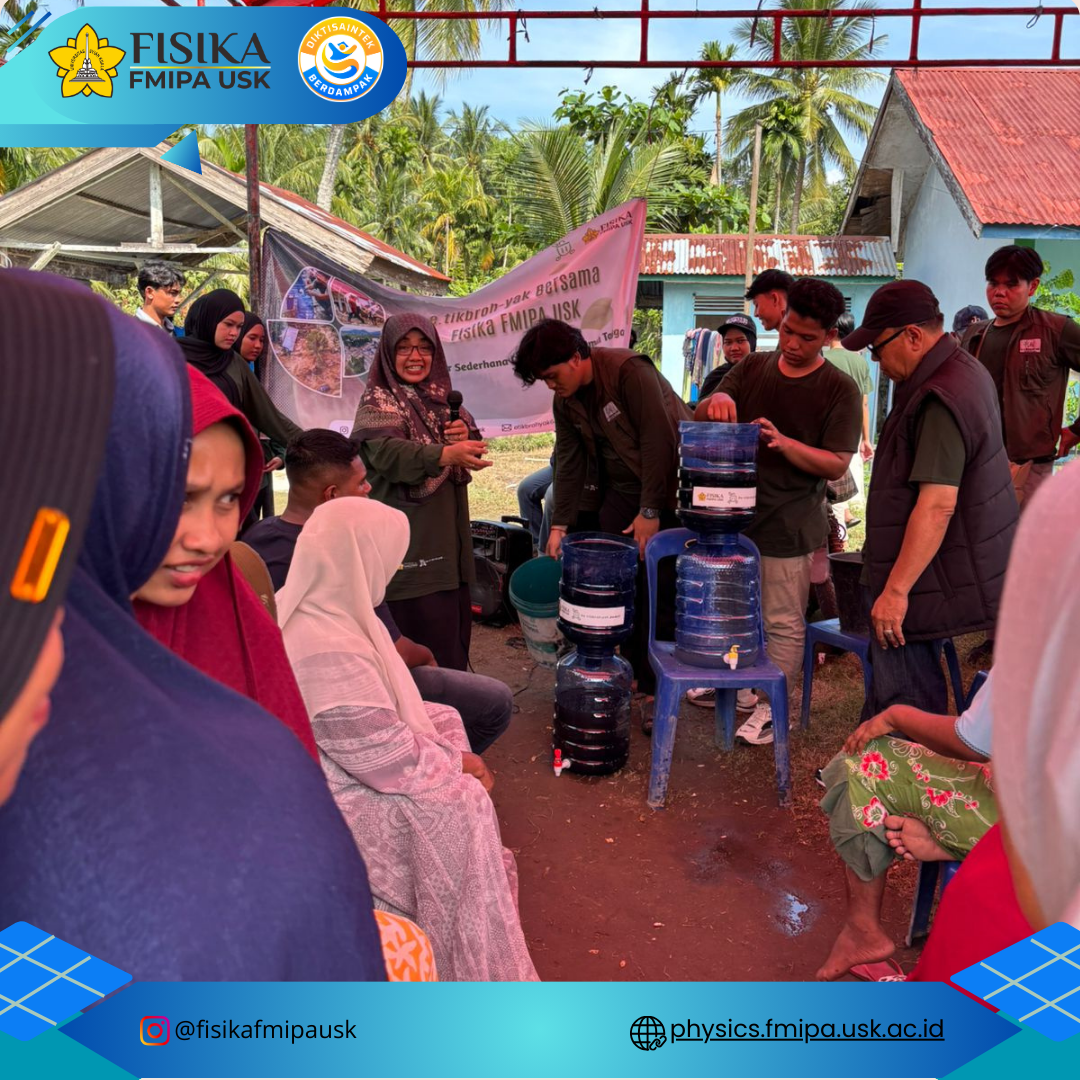
In response to this situation, the Physics team from FMIPA introduced an appropriate technology solution in the form of a simple household water filtration system called the “Rakita” filter. The system can be assembled using locally available materials such as PVC pipes, silica sand, gravel, and activated carbon. This approach was chosen to ensure that communities not only receive immediate assistance but also gain the technical knowledge needed to build and maintain their own water filtration systems in the long term.


Donations from USK partners and cross-regional community networks were distributed in the form of 50 household-scale Rakita filter units, kitchen equipment such as cooking pots and pans, kitchen hygiene supplies including dishwashing soap and supporting tools, as well as spiritual assistance in the form of Qur’ans and sarongs.
In addition, ready-to-eat rice meals were distributed through a collaboration between Bogor Agricultural University (IPB), the Department of Agricultural Product Technology (THP), Faculty of Agriculture USK, and the USK Disaster Task Force. Fresh food support also came from the Kyoto-Aceh community and alumni of the Sakura Change Program, who contributed 50 kilograms of chili peppers, along with additional logistics from Rumah Amal USK.
All assistance was delivered directly to priority households, particularly families with toddlers, elderly members, and school-aged children.
Beyond the distribution of supplies, the team also conducted community training on assembling and maintaining the Rakita water filter at the village meunasah (community prayer hall). Dozens of youth and housewives participated in hands-on sessions to learn how to arrange the filtration media, measure water flow, and maintain the system for sustainable use.

At the same time, USK volunteers organized psychosocial support activities for children in Lhok Puuk Village through educational games. The children were encouraged to share their disaster experiences, draw their dream homes, and participate in simple science games designed to help restore their sense of safety and emotional well-being.
The program coordinator, Rizanna Rosemary, emphasized that the assistance was designed based on real needs observed in the field.
“Since the SENYAR Aceh disaster occurred, we witnessed firsthand how wells have become both a source of problems and a source of hope for residents. That is why the Physics team from FMIPA wanted to contribute using the knowledge we have. The Rakita filter is very simple and affordable; one unit can be used for years if properly maintained. God willing, residents will no longer need to buy expensive bottled water or rely on unsafe river water,” Rizanna explained.
She also highlighted that the involvement of e-TikBroh.YAK helped expand the reach of the humanitarian initiative.
“Digital communication through e-TikBroh.YAK connects the concerns of many stakeholders, from application users and diaspora communities to university partners. We collect data on residents’ needs and convert donations into the most urgent assistance, especially clean water access and child recovery programs. This shows that environmental digital platforms can evolve into humanitarian platforms,” she added.
Rizanna further emphasized that the program will continue beyond this initial intervention.


“This two-day activity is not the end. The USK Task Force and FMIPA Physics team are currently mapping other villages in North Aceh and Pidie Jaya that still face difficulties accessing clean water. We hope to reach every village in need. Our goal is for this assistance to become a collective movement, not the work of a single institution,” she said.
Representatives from FMIPA USK also expressed their appreciation to all donors and partners involved, including IPB University, the Department of Agricultural Product Technology (THP) of the USK Faculty of Agriculture, the USK Disaster Task Force, the Kyoto-Aceh community, Sakura Change Program alumni, and Rumah Amal USK.
This multi-institutional collaboration is considered essential, as the recovery process following the SENYAR disaster requires a multi-sector approach, including clean water technology, food support, household hygiene supplies, and psychosocial assistance for children.
The program is expected to help communities meet their basic needs more independently, strengthen community-based science literacy, and provide a safe and supportive environment for children to regain hope and enthusiasm after the disaster.