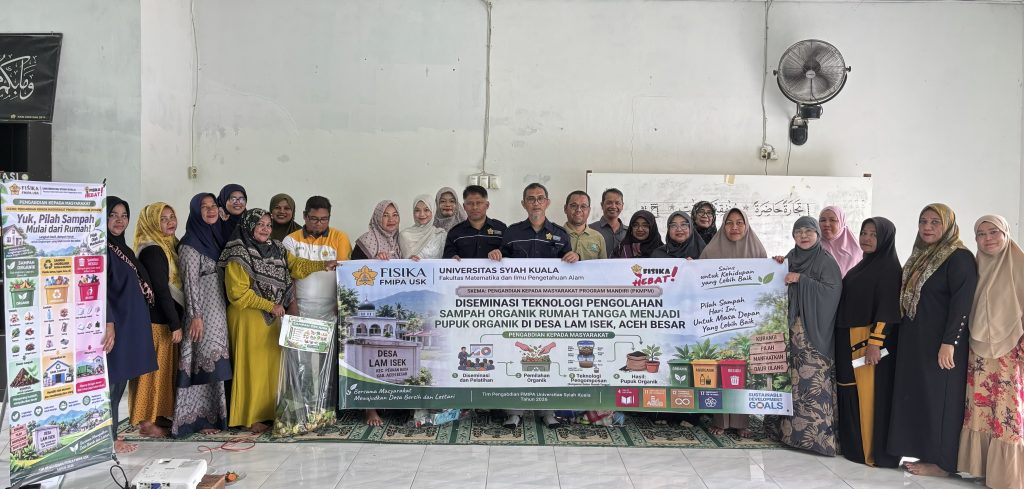
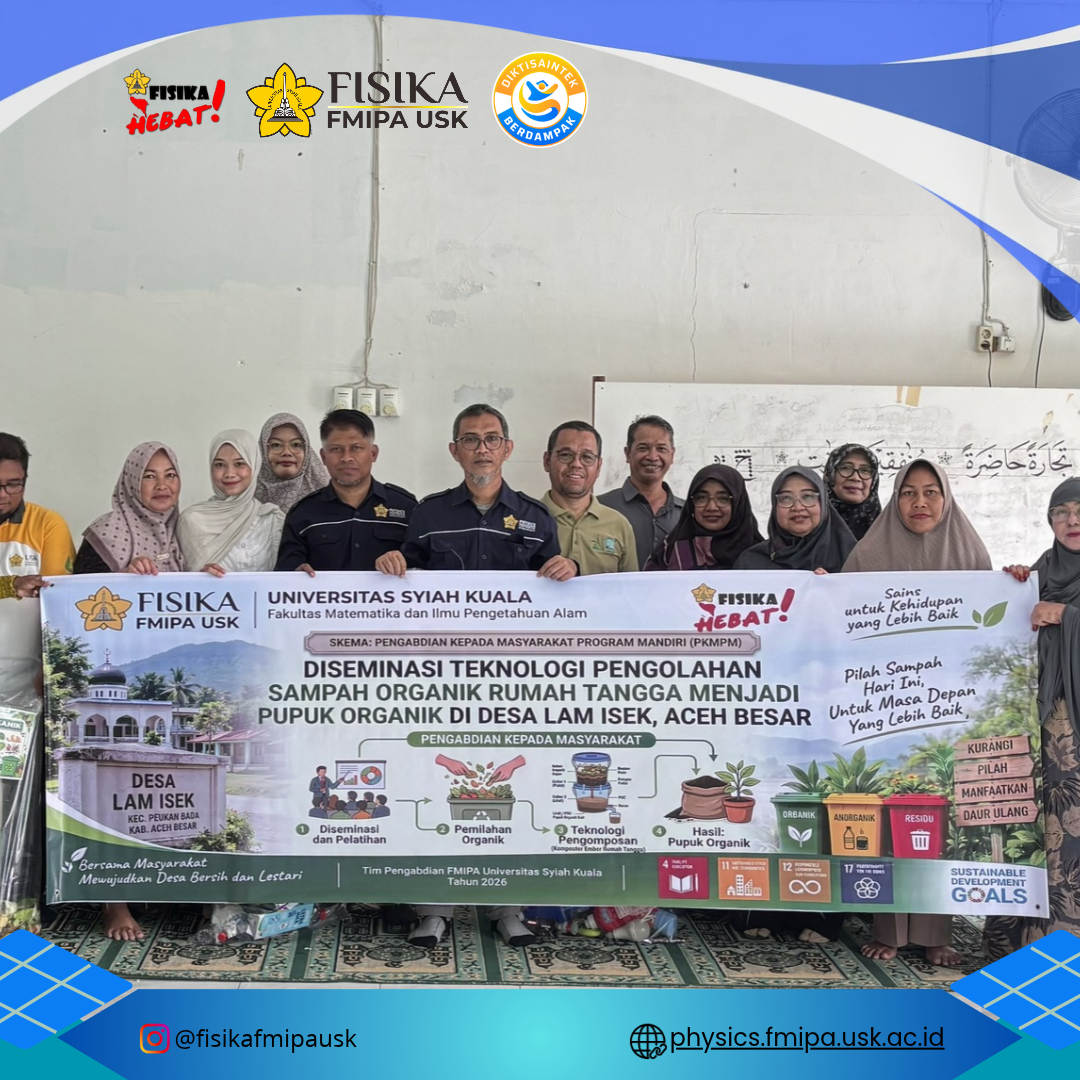
Banda Aceh – A team of faculty members from the Department of Physics, Faculty of Mathematics and Natural Sciences (FMIPA) at Syiah Kuala University (USK) held an independent community service program in Lam Isek Village, Peukan Bada Subdistrict, Aceh Besar Regency, on Saturday (September 19, 2026). Under the theme “Dissemination of Household Organic Waste Processing Technology,” this activity encouraged local housewives to transform kitchen waste into useful organic fertilizer.
This initiative was prompted by the challenge of managing vegetable, fruit, and leaf waste, which often causes environmental problems such as pungent odors, pollution, and high volumes of final disposal. To address this, the USK team, led by Irhamni, S.Si., M.Si., along with five faculty members and two students, introduced a simple, inexpensive, and easy-to-implement waste-processing method.
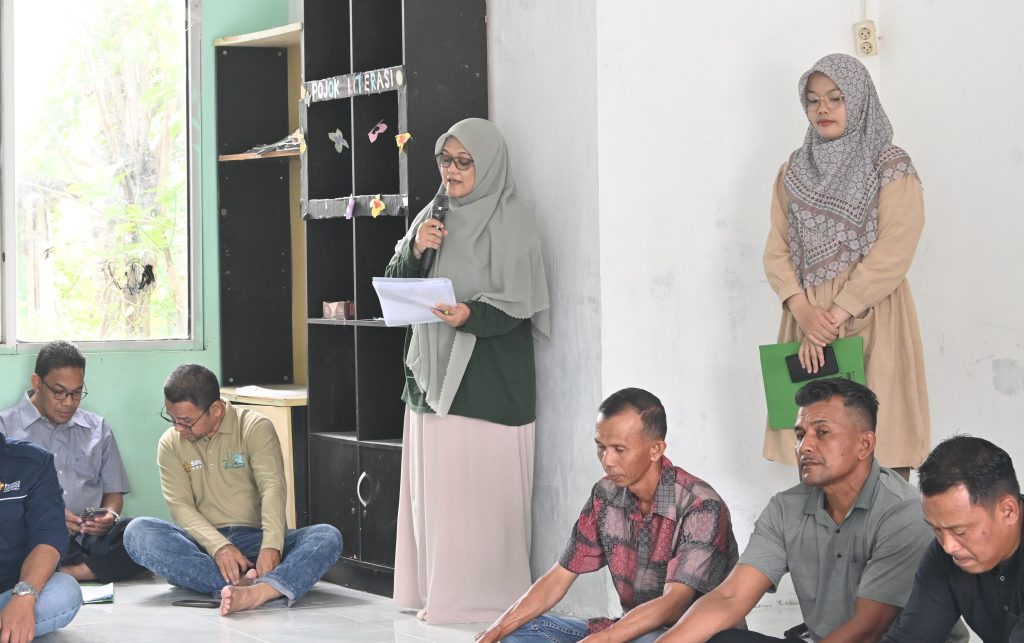
The community service team leader demonstrates household organic waste processing technology.
Irhamni, as the Community Service Team Leader, emphasized that proper organic waste management can provide dual economic benefits for the community.
“Household waste is still useful if managed properly. It can be utilized as fertilizer for home gardens. Small-scale gardening in one’s backyard is also beneficial for daily needs. Let’s turn kitchen waste into valuable fertilizer,” said Irhamni.
The activity went beyond theoretical instruction. Residents received a comprehensive explanation of the waste sorting process, the basic principles of composting, and how to manage moisture and aeration. Afterward, residents were invited to gain hands-on experience producing organic fertilizer under the guidance of Dr. Malahayati, a physics lecturer at USK who served as both a resource person and a practitioner with a proven track record of implementing similar technology in her own backyard.
The university plans to continue this mentoring as a sustainable long-term program. The Chair of the Department of Physics at USK’s Faculty of Mathematics and Natural Sciences (FMIPA) envisions that Lam Isek Village could become a model for environmental self-sufficiency in the future.
“We hope that the village will receive ongoing mentorship beyond one or two activities and become a partner village collaborating with the Department of Physics. Beginning with waste management, we aim to establish a village waste bank over time, enabling the community to make productive use of waste and generate economic value,” he explained.
The residents’ enthusiasm showed in their active engagement during the discussion and hands-on sessions. Dara, a local village leader, welcomed the USK academic community’s initiative and hopes the program can continue in her village.
“I hope events like this continue to be promoted over time. Regular outreach can help make waste reuse a lasting habit within the community,” she said.
Through the dissemination of this technology, the residents of Lam Isek Village are expected not only to reduce the volume of waste disposed of in the environment but also to be able to produce organic fertilizer independently. This step marks the beginning of the establishment of a community-based, environmentally friendly, and sustainable waste management system in Aceh Besar Regency.